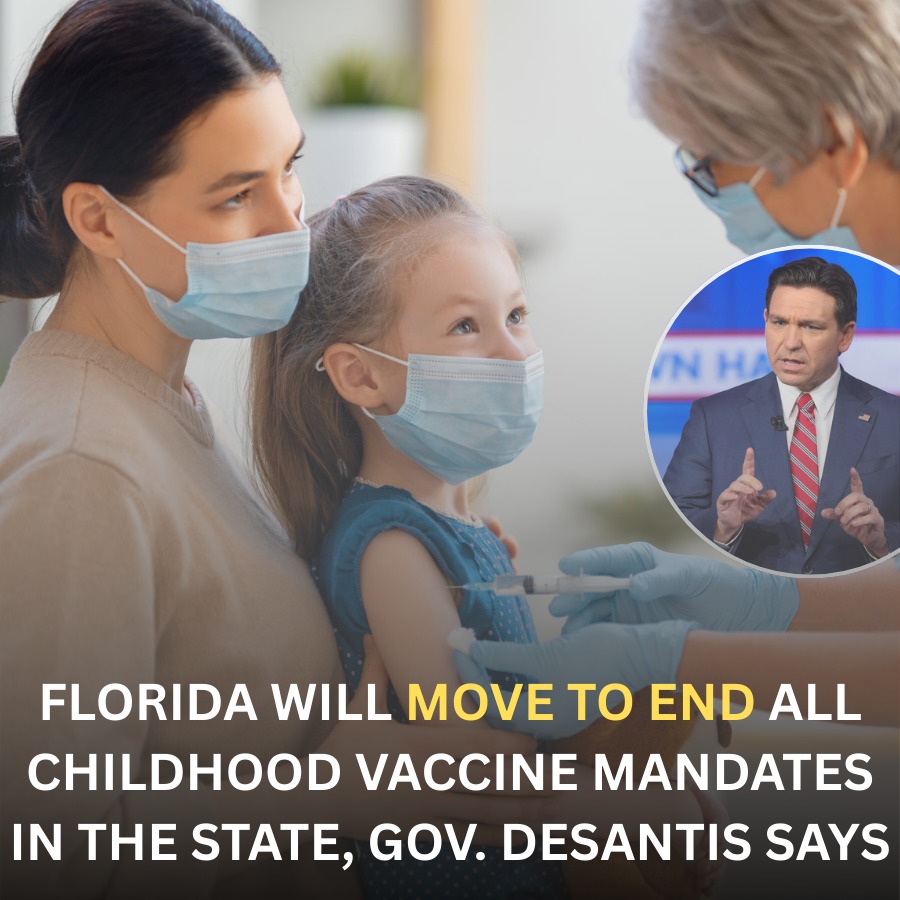
Florida Governor Ron DeSantis has never shied away from taking bold and politically charged positions, but his announcement on September 3, 2025, may be the most sweeping public-health move any state has attempted in modern history: a full repeal of all vaccine mandates statewide. If enacted, Florida would become the first state in the country to eliminate every single vaccination requirement — including those governing school admission, childcare, college enrollment, nursing homes, and various health-facility settings. It’s a move that supporters hail as a victory for personal autonomy and opponents warn could reverse decades of disease prevention.
The proposal, crafted alongside Florida Surgeon General Dr. Joseph Ladapo, is framed as part of a broader “medical freedom” platform designed to shift authority away from state institutions and toward individual families. At the Valrico event announcing the plan, DeSantis and Ladapo described mandates as outdated, overly aggressive, and incompatible with modern understandings of parental rights. Their language was sharp, framing the push as correcting what they view as an era of overreach during the pandemic years.
The stakes, however, extend far beyond pandemic politics. Florida’s longstanding vaccine requirements cover a broad portfolio of preventable diseases — measles, polio, pertussis, hepatitis B, and more — and have been a staple of school safety for generations. Undoing them would not only transform the state’s public-health strategy but also signal to other states, especially conservative-leaning ones, that dramatic changes to immunization policy are politically possible.
The Announcement: A Sweeping Philosophical Pivot
Speaking before an enthusiastic crowd, Ladapo argued that decision-making power should rest entirely with families. “Who am I to tell you what your child should put in their body?” he said. Framing existing requirements as a form of government intrusion, he denounced mandates as “immoral” and incompatible with informed consent. While his comments drew applause from attendees, they also triggered immediate concern among health experts who view childhood immunization as a foundational tool for disease control.
Governor DeSantis tied the proposal to themes that have defined his policymaking since 2020: parental choice, skepticism of federal guidelines, and limiting government authority. Throughout the pandemic, Florida leaned heavily into maintaining personal and economic normalcy — avoiding school closures, opposing vaccine passports, and resisting workplace mandates. DeSantis argued that this approach was vindicated, offering proof that families could be trusted to make their own health decisions without state enforcement.
The new proposal takes those principles further than ever before.
What the Plan Actually Does — and When
Despite the sweeping rhetoric, Florida’s vaccine-mandate elimination plan is unfolding in two stages: rules the Department of Health can change immediately, and laws the Legislature must repeal or rewrite in 2026.
Phase 1: Rule Changes (Early December 2025)
The Florida Department of Health has authority over certain early-childhood vaccine requirements through administrative rules. Under this authority, mandates for the following vaccines are scheduled to be removed by early December:
Hepatitis B
Varicella (chickenpox)
Hib (Haemophilus influenzae type b)
Pneumococcal conjugate
These doses have long been required for childcare centers and early school entry. Removing them requires no legislative vote, only a regulatory amendment.
Phase 2: Full Repeal (January–March 2026 Legislative Session)
Florida law still mandates several other vaccines for K–12 schools, colleges, and certain care facilities. These include:
Measles, Mumps, Rubella (MMR)
Polio (IPV)
Diphtheria-Tetanus-Pertussis (DTaP)
Meningococcal
Other age-specific immunizations
These statutes cannot be undone by rule changes alone. DeSantis will need majorities in both chambers of the Legislature to enact the full repeal as part of an anticipated “medical freedom package.”
Republicans hold strong majorities in Tallahassee, but leadership has not publicly committed to backing the proposal — an indication that even in conservative circles, the issue is complex.
The Political Strategy: A Fusion of Parental Rights and Post-Pandemic Sentiment
For Governor DeSantis, who is widely expected to seek another term in 2026 or potentially return to national politics, the vaccine-mandate repeal aligns with broader themes he has emphasized:
“Parents, not bureaucrats, should make medical decisions.”
“One-size-fits-all policies are relics of the past.”
“Florida will chart its own course, not follow federal mandates.”
His 2025 rollout also comes paired with the creation of the “Make America Healthy Again Commission” (MAHA) — a state-level counterpart to a similar federal initiative announced earlier in the year. Chaired by First Lady Casey DeSantis, MAHA is tasked with reviewing nutrition, wellness strategies, and health policy through a lens of “personal empowerment” and reducing reliance on pharmaceuticals.
This framework resonates with segments of the electorate who felt alienated by pandemic-era restrictions and continue to express skepticism toward institutional health guidance.
Surgeon General Joseph Ladapo: The Architect Behind the Policy Shift
Dr. Ladapo has been one of the most unconventional state health leaders in the country since his appointment in 2021. A Harvard-trained cardiologist, he has diverged from federal health guidance on everything from fluoride in drinking water to COVID-19 vaccination for minors. His approach has emphasized autonomy, caution regarding new medical products, and what he describes as avoiding “medical coercion.”
Ladapo’s critics argue that this stance sometimes clashes with established public-health evidence. Supporters counter that he brings an overdue willingness to challenge long-held assumptions.
His views on vaccine mandates — likening them to “tyranny” or “control” in previous remarks — have signaled for years that a move like this might be coming.
What Florida Requires Today — and What’s at Stake
As of late 2025, Florida’s immunization schedule mirrors national standards for schools and childcare facilities. The list covers several diseases once common in the United States but now largely kept at bay through widespread vaccination.
These include preventable illnesses like:
Measles
Polio
Pertussis (whooping cough)
Rubella
Diphtheria
Many Florida parents likely don’t remember these diseases firsthand, which health experts say is precisely because mandates kept them rare.
Removing mandates doesn’t ban vaccines; it simply stops requiring them for participation in school or childcare. Families could still choose to vaccinate their children — and many are expected to do so regardless of state policy.
What concerns medical groups is the potential for pockets of unvaccinated children to create vulnerabilities in communities where diseases can spread once again.
Reactions Across the State and Nation: A Deep Divide
The announcement has been met with an immediate split in responses — passionate on both sides.
Supporters Praise a “Freedom-First” Breakthrough
Advocates in medical-freedom circles call the move historic. They see it as the culmination of a shift begun during the pandemic, one that prioritizes informed consent over government instruction. Many frame it as a victory for parents who felt unheard or sidelined in debates about school policy in 2020–2022.
For them, Florida’s plan represents a rebalancing of power — away from institutions and toward families.
Opponents Warn of Public-Health Consequences
Major medical associations have released sharply worded statements expressing alarm. Their concerns focus on:
Potential drops in school immunization rates
Increased vulnerability to preventable disease
Risks to children who cannot be vaccinated for medical reasons
Some former public-health officials have called the plan “unprecedented” and warn it may place Florida at risk of future outbreaks.
Pediatricians across the state — many of whom see vaccine-preventable illnesses early and firsthand — have expressed concern that misinformation, not science, is guiding policy.
Florida Democrats: “This Is About Politics, Not Children”
State Democratic leaders describe the move as ideological, not data-driven. Many have pledged to fight full repeal in the Legislature, arguing that vaccine mandates protect schools, protect medically fragile children, and save parents from missing work during avoidable outbreaks.
One lawmaker said Florida was “putting itself on an island at the worst possible time.”
Could Other States Follow Florida’s Lead?
Public-health experts believe Florida’s actions may embolden other conservative states — particularly those that similarly resisted pandemic restrictions — to consider partial rollbacks. States like Arkansas, Alabama, and Oklahoma have debated narrower versions of such policies since 2021.
Whether those states move as aggressively as Florida remains unclear. Many have strong ties to hospital systems and medical universities that rely on high vaccination rates.
For now, Florida is the bellwether.
What Happens Next?
The next six months will determine whether Florida becomes the nation’s first fully mandate-free state.
Key milestones include:
December 2025: DOH rule changes take effect, ending four early-childhood mandates.
January 2026: Legislative session begins.
Spring 2026: The “medical freedom package” is expected to be voted on.
If the proposal passes in full, Florida’s school and public-facility immunization policies will be rewritten for the first time in nearly half a century.
If it fails, Florida will still have rolled back more vaccine mandates than any other state in the country — but not as extensively as DeSantis envisions.
A Defining Moment for Public Health and Politics
Florida’s vaccine-mandate elimination proposal is more than a public-health policy. It is a reflection of the country’s evolving relationship with science, trust, institutions, and personal autonomy. It reflects how deeply the pandemic reshaped public expectations about government authority. And it highlights the tensions between individual freedom and collective welfare that have defined much of the past decade.
Whether Florida’s plan becomes a landmark shift or a brief political diversion, it will be studied for years — by parents, policymakers, health officials, and political strategists nationwide.
In the meantime, Florida is preparing for a fight in the Legislature, a surge of national attention, and a new chapter in the country’s ongoing debate over what freedom really means in matters of public health.

